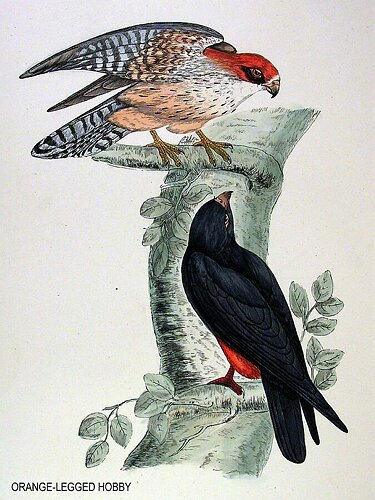
ORANGE-LEGGED HOBBY.
Falco rufipes, BECHSTEIN. Falco vespertinus, GMELIN. LINNAEUS. LATHAM.
Falco—To cut with a bill or hook. Rufipes. Rufus—Red.
Pes—A foot.
There is not much at present to be said about the species
before us, and it is so far well, in that it allows the greater space
to treat of other more common, and therefore better known, British
Birds. In a work of this kind, it is, for the most part, room and
not matter that is wanting; 'brevis esse laboro,' and it is a matter
of regret that I am obliged to do so, but a necessarily short article
in the one case leaves the more scope for a longer one in another.
The Orange-legged Hobby, delighting in a mountainous and at the same
time wooded region, is common in some parts of Europe, but rare in
others. It is plentiful in Russia, Silesia, Hungary, Poland, Greece,
Turkey, and Austria; less so in Italy, Switzerland, and the Tyrol;
uncommon in Sweden, Finland, Spain, and France, and unknown in Holland.
In Asia its range extends to Siberia, from Persia and Palestine. In
Africa it arrives in very large numbers in Demaraland and Benguela,
and has been obtained in Algeria.
But very few examples of British specimens of this species have as
yet been obtained. In Yorkshire, two near Doncaster, and a male has
been recorded by Gr. S. Foljambe, Esq. to have been obtained some
years since; another, a female, is said to have been shot at Rossington,
near Doncaster; a fifth, also a female, was killed a few years ago
near Easingwold, and was sent to Mr. H. Chapman, of York, to be preserved,
with a message that if it was a cuckoo he was to stuff it for the
person who shot it; but that if it was not a cuckoo, he might, if
he stuffed it, keep it for his payings. A sixth was shot on the 6th.
of May, 18—, at Stainor wood, near Selby; a seventh near Selby,
by Edward Dawson, Esq., of Osgodby Hall, and an eighth at Barmston,
in the East Riding, by John Bower, Esq. Three were obtained together
in the month of May, in the year 1830, at Horning, in the county of
Norfolk, an adult male, a young male in immature plumage, and an adult
female. A fourth specimen, a female, was also shot in Holkham Park,
the seat of Mr. Coke, (Lord Leicester;) a fifth in the same county,
in the year 1832; and a sixth, a male in adult plumage, in August,
1843, near Norwich—its stomach contained only beetles. Two have
been procured, both males, near Plymouth, as I am informed by Mr.
R. A. Julian, of that place.
The first he says flew on board a vessel in the Channel near the Breakwater,
and was captured; the other was brought to Mr. Pincombe, bird preserver
of that town, by a person who shot it at Wembury cliff, and who said
that he saw another of the same kind in company with it; a third also
in Devonshire, near Kingsbridge, about 1840: one, a male, at Rose
Merryn, near Mawnan, Cornwall. One has been obtained in the county
of Durham. Specimens have also been had in Berkshire, Shropshire,
Northumberland, Suffolk, Surrey, Kent, and Sussex.
In Scotland it had hitherto been unknown but two have more recently
been killed near Aberdeen. In Ireland one, (and possibly another,
but it is uncertain,) was procured in the county of Wicklow in the
summer of 1832. It was shot just as it had pounced on a pigeon, of
at least its own size, in a gentleman's yard—both fell dead
at the same discharge.
Mr. Meyer says, 'I have more than once seen this bird, but have not
been so fortunate as to obtain it. On one occasion, in the summer
of 1838, I was late one evening walking in the unenclosed plantations
belonging to Claremont, on a heath on which I knew they were sometimes
found, when my advance aroused from the ground a bird, whose peculiar
flight instantly arrested my attention, and I followed it as far as
the enclosure of the plantation into which it had entered would permit;
I presently perceived it sitting upon the branch of a tree, in company
with another bird of similar size, but differing in colour. I was
near enough to observe their plumage, and no doubt remained upon my
mind respecting them—they were Orange-legged Hobbies.'
It is of migratory habits, going northward in April, for the summer,
and back to the south for the winter.
The food of this species consists of the smaller birds, such as quails,
and even occasionally those that are much larger, as the pigeon just
mentioned, lizards also, beetles, dragonflies, and other insects.
In pursuit of the latter, taken by them on the wing, it is seen skimming
over watery places until late in the evening—a habit also of
others of the Hawks—uttering its note from time to time. One
of its Latin specific names, 'vespertinus,' (of, or belonging to the
evening,) is doubtless hence derived.
The note, or cry, rather, resembles that of the Kestrel, but is related
to be uttered less frequently.
Its nest is said to be built in the hollows of trees, and it is also
stated that use is sometimes made of that of a magpie or other bird.
The eggs are from four to six in number, the ground colour yellowish
white, mottled and blotted with two or three shades of light orange
brown.
Male; length, about eleven inches; bill, yellowish white at the base,
the rest horn-colour, inclining to yellowish brown towards the tip;
cere, reddish orange; iris, dark brown; head, crown, neck, nape, chin,
throat, breast, and back, dull lead-colour. The wings reach all but
to the end of the tail, and have the quills light dull lead-colour,
with brownish black shafts; the second feather is the longest in the
wing, being about half an inch longer than the first and third, which
are of an equal length. Greater and lesser wing coverts, primaries,
secondaries, and tertiaries, of the same dull leaden hue; tail, dull
lead-colour; tail coverts, the same; under tail coverts, deep ferruginous;
legs, which are feathered in front more than one third down with deep
orange ferruginous, and the toes, bright red. The claws, yellowish
white with dusky tips. It seems possible that the white colour may
be the result of age.
The female has the head and back of the neck yellowish red; the lower
parts, light yellowish red, with longitudinal brown spots. When old,
the plumage is said to become lighter in colour, and the black bars
narrower. Length, about twelve inches; bill, yellow; iris, yellow;
forehead, whitish; crown, pale rufous; neck, on the back part, and
nape, dark reddish brown or yellowish red, as is also the moustache,
sometimes approaching to black. The back is barred with greyish black.
The chin and throat, nearly white, having a slight reddish or yellowish
tint; breast, pale rufous brown, tinged with cinereous, with dark
reddish-brown longitudinal streaks; the shafts of the feathers and
a spot near the tip, dark brown. These marks are said to disappear
with age. The back, greater and lesser wing coverts, blackish grey
or bluish grey, transversely barred on each feather with bluish or
greyish black; the quills, blackish grey on the outer webs, and tips,
and transversely barred with white on the inner; under wings coverts,
rufous, with transverse bars of dark brown; primaries, secondaries,
and tertiaries, dusky black. The tail on the upper surface, as also
the tail coverts, blackish grey or bluish grey, transversely barred
with bluish black; on the lower surface it is bluish grey, with nine
or ten bars of bluish black, shewn through from above, the bars gradually
wider in the direction of the tip; under tail coverts, light yellowish
orange, (Meyer says white,) as are the feathers on the legs. The legs,
and toes, deep orange yellow; claws, as in the male.
The young male is at first similar in plumage to the young female,
but at the first moult it assumes a general bluish grey colour, the
feathers on the legs being ferruginous; the bill, cere, legs, toes,
and claws, are like those of the old bird.
The young female has the bill, cere, and iris, as in the adult; crown
of the head, reddish brown with dusky streaks, the feathers tipped
with light red—a small moustache descends from the front of
the eye; neck on the sides, pale reddish or yellowish white, with
longitudinal brown streaks and blots. The throat, white; breast, as
the sides of the neck; back, dark brown, the feathers being tipped
with reddish brown. Wing coverts, the same; primaries, secondaries,
and tertiaries, dusky black, the inner edges and the tips being buff
white. The tail, dark brown, crossed with numerous bars of reddish
brown; under tail coverts, deep ferruginous; legs, toes, and claws,
as in the adult.
"Let the wild Falcon soar her swing. She'll stoop when she has
tired her wing."
Marmion.